Day 02
So - this turns out to be a bit more tricky that I first thought. The problem sounds like it should be ok to solve.
-
You have to parse the file into the pairs. You can do this with
textread()in matlab by specifying the delimiter as,- and you will end up with a piece of text that contains the ranges of IDs. E.g.11-30or12344-14999or smilar -
Splitting on the
-will give you the start and end of the range for each pair. This can be done withregexp(data,'-','split')or a similar call -
Then you can loop over each pair, and generate the list of IDs in that range with
startID:endID- but be careful here - the IDs can be very large. So you may need to useuint64or similar to avoid overflow.
It turns out that doing this in Matlab is a bit of a pain, but julia (https://julialang.org/), which is very similar to Matlab, makes this a lot easier because it has built-in support for big integers.
Tips
- in
matlab, for a smaller scale problem, you can useuint64to represent large integers - ranges:
1:100generates a vector of numbers from 1 to 100 … for most pairs this will work, but some very large numbers will overflow standard integer types julia: UseBigInt(num)to convert a number to a big integer
Second problem
The second part of the problem is a bit more tricky. Now you have to find all IDs that are invalid in a more complicated way - any ID that’s made up of 2 or more repeating chunks e.g. 1212 (2 chunks of 12), 123123123 (3 chunks of 123), 999999 (6 chunks of 9), 12341234 (2 chunks of 1234) are all invalid.
-
key idea is to subdivide the number (as a string) into sub-chunks of a given size and check if all chunks are the same
-
julialist comprehension is very useful for this!
# say
iChunk = 3
nChunks = Int(nDigits / iChunk)
# this will get you a list of all the chunks....
chunks = [SubString(str,1 + (i-1)*iChunk, i*iChunk) for i = 1:nChunks]
-
if these chunks are all the same, you can check with
unique(chunks)- if the length of this is 1, then they are all the same! Neat trick. -
This was quite hard because of the size of the numbers and building the ranges. I’d say not a beginner problem at all …
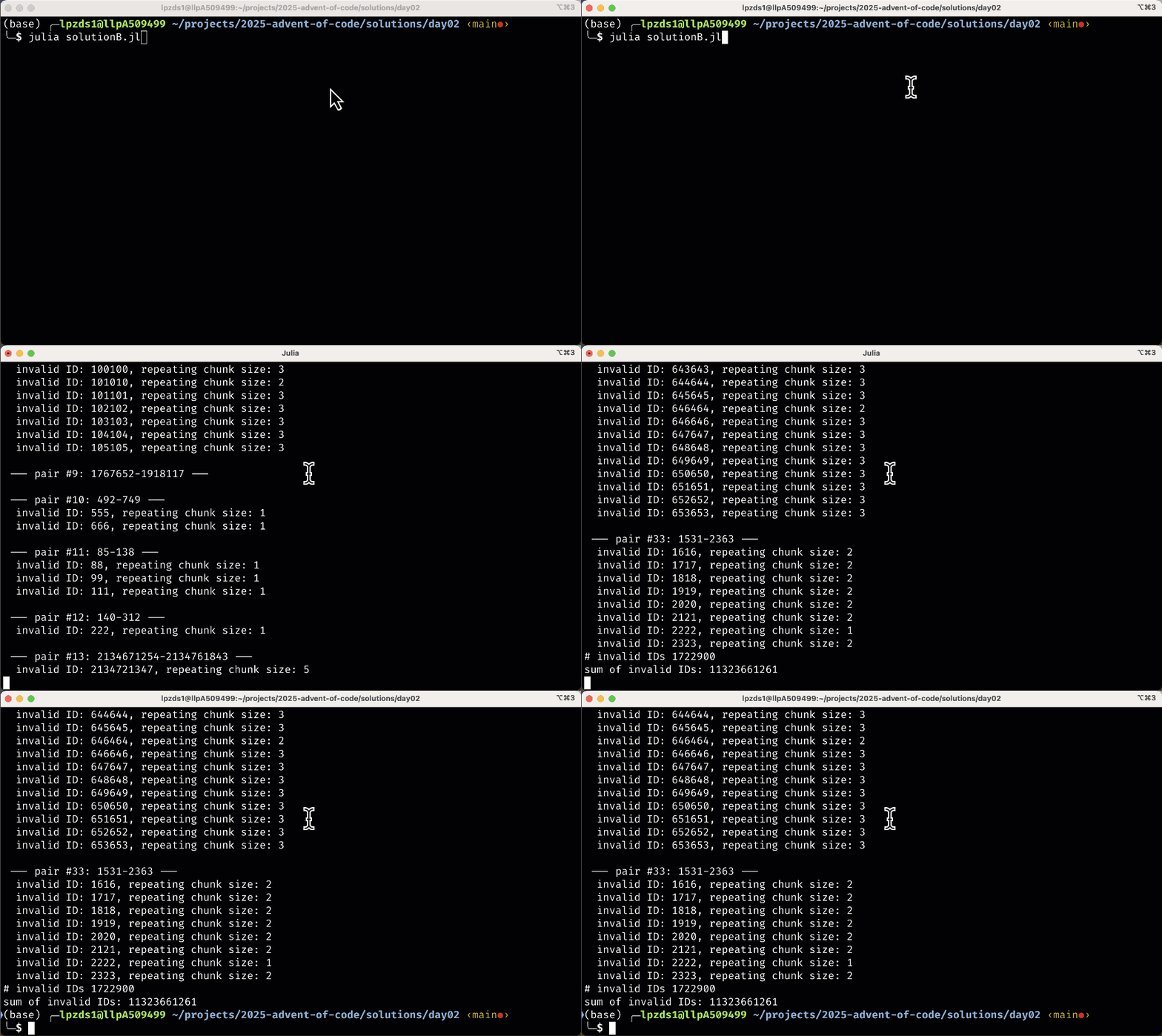
Code
Julia solution (not easy!)
Julia code / solution for the first part of that problem.
Second part solution of that problem.